View recipes
Check the reference data for the selected food.
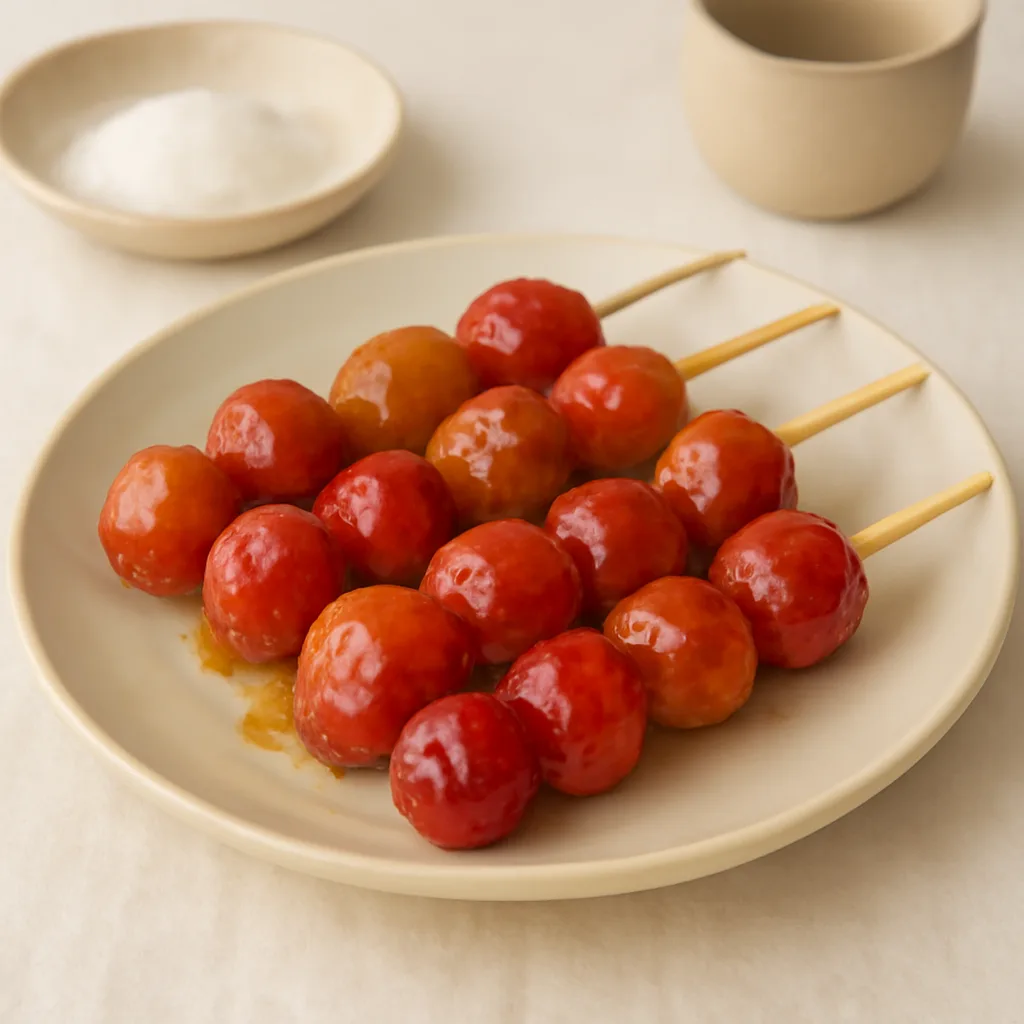
About this recipe
Tanghulu is a dessert where completely dried fruit is enrobed in a thin hot sugar syrup, delivering the contrast of a hard, crisp coating and the fruit’s refreshing moisture. The cooking time is about 20 minutes, but what determines the final result is the syrup color and viscosity, and the surface dryness of the fruit. Choose fruits that hold their shape well enough to stay securely on skewers. If there is moisture on the surface, the syrup may not coat evenly or may splatter, so after washing, pat dry with a kitchen towel and let them dry thoroughly. A syrup made by boiling sugar and water in a 1:1 ratio is ready for coating when it turns golden and gains viscosity from a thin syrup. However, if boiled to too dark a brown, it can taste bitter, so in the late stages when color changes rapidly, adjust the heat and observe closely.
Taste and Texture
A well-set tanghulu first cracks with a thin sugar film, followed by the juicy, refreshing taste of the fruit. If the fruit has acidity, the sweetness can feel even more pronounced. If the syrup layer is too thick, sweetness and hardness can overpower the fruit’s flavor. Conversely, a thin, even coating lets the crisp sound and the fruit’s texture come through more balancedly.
Key to making it delicious
- Wash the fruit and dry the surface and around the stems completely. If any water droplets remain, hot syrup can splatter or the coating may be blotchy, so if any damp-looking parts remain, dry again and skewer.
- Pour the syrup by boiling sugar and water at a 1:1 ratio, then once it boils, adjust to a low heat. At the stage when it starts to turn golden, the color can darken quickly, so do not leave the pot unattended for long.
- Prepare skewers of fruit to be dipped in advance. Once the syrup reaches the proper consistency, skewers should be ready so the syrup can thicken further while you prepare them.
- After dipping the fruit, slowly lift it so excess syrup pools to one side. If the coating is not even, give a light turn once to coat, and dipping multiple times will create a thicker layer.
- Place coated skewers on a sheet of parchment paper or wax paper, making sure they do not touch each other. If the skewers touch before the syrup hardens, the surface may stick or crack.
Common mistakes
- If the finished coating is tacky and will not crack, the syrup may not have reduced enough. Next time, check for golden color and viscosity, and once a single drop dropped on parchment reduces spreading, coat accordingly.
- If there is a bitter taste or strong char aroma from the syrup, it may have been overheated past the golden stage. When it turns a light golden color, lower the heat, and turn off before it progresses to a dark brown for safety.
- If syrup slides off around the fruit, surface moisture or juice may be the cause. Dry the fruit more thoroughly, and avoid fruits that are too soft or have many cut surfaces for coating.
- If the fruit cracks when skewered, the skewer may be too thick or the fruit too soft. Skewer slowly, and prepare firm whole fruits or large pieces rather than small pieces for easier piercing.
- When handling syrup, do not touch or wipe off hands or work surfaces immediately if it splashes. Hot sugar syrup is very sticky, so in environments with children nearby or unstable workspace, it is safer to postpone cooking.
Application Ideas
- Using fruits with acidity can make the sugar coating feel less heavy, so try this if you find sweetness too much with very sweet fruits.
- Combining multiple fruits cut to the same size on one skewer creates color and flavor contrasts. If using watery fruits with hard fruits, be sure all surfaces are thoroughly dried for even coating.
- Preparing fruit in a size that can be skewered stably helps maintain shape more easily. Very small pieces of soft fruit can fall into the syrup, so this is not ideal.
- A thin single coat yields a lighter tanghulu where the fruit flavor remains central. If a thicker coating is desired, sweetness and hardness will increase significantly, which may not suit when you want the fruit’s freshness.
Pairing ideas
- Serve immediately on the skewer after the syrup hardens for a striking contrast between the crisp coating and fruit.
- Place skewers on parchment or wax paper with spacing to prevent coating from sticking together and to make it easier for guests to pick one up.
- Prepare several small fruit skewers on a platter to offer color and size variety for easy selection.
- If using fruit chilled, wait until the surface hardens after coating before serving. Cold fruit can leave surface moisture that makes the crisp coating sticky, so wipe away any moisture before serving.
Essential ingredients
과일
Optional ingredients
No separate optional ingredients.
Cooking order
Wash the fruit thoroughly and pat dry, then cut into desired sizes.
In a pot, combine sugar and water in a 1:1 ratio and bring to a boil over medium heat.
When the sugar dissolves and the syrup begins to boil, reduce the heat and simmer until golden.
When the syrup reaches the proper consistency, turn off the heat and thread the fruit onto skewers.
Dip the skewered fruit into the syrup to coat evenly.
Place the coated fruit on parchment paper or a silicone mat to cool.
Once the syrup hardens, the crispy tanghulu is ready.