Voir les plats
Vérifiez les données de référence des aliments sélectionnés.
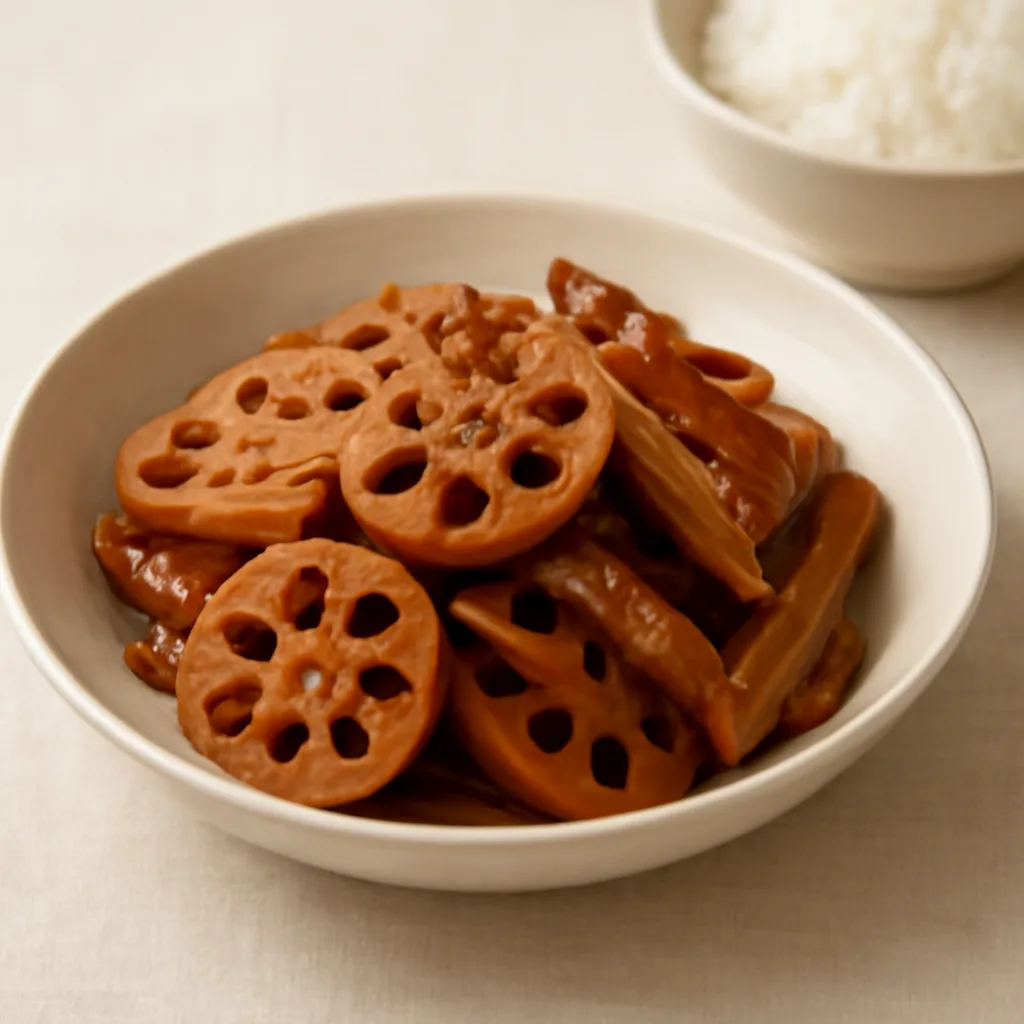
Rutabaga et bardane braisés
Un plat d’accompagnement braisé à la sauce soja à base de racine de raphanus (daikon), bardane, carotte et champignons shiitake; caractérisé par une saveur douce-salée et sucrée. Se marie bien avec du riz.
5
Consultation0
J'aime1
Recommandation AI0
CrééÀ propos de ce plat
Korean-style lotus root and burdock braise is a savory-sweet side dish that braises firm root vegetables and shiitake mushrooms in a soy sauce, sugar, and garlic seasoning to accompany a meal. Slice lotus root to a consistent thickness to emphasize the cross-sectional holes and crisp texture; cut burdock not too thick so it becomes tender in roughly the same time as the lotus root. The key to the braise is reducing enough water to submerge the ingredients and then simmering slowly to balance the sauce. When the liquid has reduced to about half and the surface of the ingredients glistens with a brown color, and if you press the thickest lotus root piece and it is cooked through, turn off the heat and let it rest briefly. However, the longer you simmer, the more the sweetness and saltiness concentrate, so if you don’t want a deep glaze with almost no liquid, leave a little broth at the end to finish. Carrot and shiitake mushrooms contain more moisture and cook more quickly than lotus root and burdock. For recipes that cook all ingredients together, thinly slice the carrot and shiitake mushrooms so they align with the cooking time of the firm ingredients.
Goût et texture
The braise combines sweet-salty flavors from soy sauce and sugar, with garlic aroma enhancing the dish, while shiitake mushrooms gently support the savoriness of the seasoning. As the braising liquid reduces, the flavor becomes more pronounced on the surface of the ingredients. Lotus root becomes crisp-tender when properly cooked, burdock provides a chewy, fibrous bite, carrots add soft sweetness, and shiitake mushrooms stay moist and chewy for contrast.
Clé pour réussir
- If you cut lotus root and burdock about 0.5 cm thick as evenly as possible, the pieces will cook at a similar pace, reducing differences where some pieces stay firm and others become mushy.
- Start with enough water to cover the ingredients, then keep the heat at medium after it boils so the liquid reduces slowly. If the heat is too high, the liquid concentrates at the bottom and the interior of the firm roots may remain undercooked.
- If the saltiness becomes strong while bubbling, don’t reduce the liquid further; instead, supplement with a small amount of water as needed until the ingredients finish cooking.
- When you turn off the heat, letting it rest briefly allows the remaining seasoning to permeate the surface and cut sides, but if you want crisper texture, don’t rest too long and serve after a short rest.
Erreurs courantes
- If lotus root and burdock vary too much in thickness, thin pieces will break easily while thick pieces stay firm. Match the thickness to the thinnest piece, and if many pieces are already thin, reduce the braising time and check the state frequently.
- Boiling on high heat until the liquid is halfway reduced can cause the bottom to scorch and the flavors not to distribute evenly. If the bottom becomes dark with sauce, lower the heat and gently swirl the pot or flip the ingredients carefully.
- If you cut carrots to the same thickness as lotus root, they may stay firm until the end. Slice them thinly or, if cut thick, check that they cook earlier than the lotus root and burdock to reach your desired texture.
- If the braising liquid is almost gone, the soy sauce and sugar concentrate more than expected, making it taste salty even with rice. When the gloss returns and a little liquid remains, turn off the heat and rest briefly to stabilize the flavors.
Idées d'application
- If you want to emphasize the chewy texture of shiitake, don’t slice them too thin; cut them slightly thicker than the lotus root so some shape stays after braising.
- For a milder flavor, don’t add all the sugar at once; taste the reduced sauce and add only part of it after tasting, using the vegetables’ natural sweetness as a guide.
- If you prefer a thicker braise with more sauce, turn off the heat a little earlier than the halfway reduction and ensure the hard vegetables are fully cooked; for a stronger glaze, braise a bit longer on a low heat while accounting for faster flavor concentration.
- If burdock’s fibrous texture is too much, increase lotus root proportion and slice burdock thinner so that, within the same seasoning, it becomes tender.
Idées d'accompagnement
- Serve with warm rice on a small plate; the sweet-salty braise enhances the rice flavor.
- If there is leftover braising liquid, drizzle a little over the lotus root and burdock to keep them moist; if the sauce is too thick, plate mainly the vegetables to avoid overpowering flavor.
- Pair with baked fish or mild tofu as a main with not-strong flavors to contrast the soy sauce taste and the crunchy vegetables.
Ingrédients essentiels
연근
우엉
당근
표고버섯
물
Ingrédients optionnels
Aucun ingrédient optionnel.
Ordre de cuisson
Éplucher la racine et l’arcade et les couper en morceaux de 0,5 cm d’épaisseur.
Éplucher les carottes et les émincer finement.
Enlever le pied des shiitake et les trancher.
Mettre la racine, l’arcade, les carottes et les shiitake dans la casserole et ajouter de l’eau pour les submerger.
Ajouter 2 cuillères à soupe de sauce soja, 1 cuillère à soupe de sucre et 1 petite cuillère d’ail haché et porter à ébullition à feu moyen.
Laisser mijoter jusqu’à ce que le jus ait réduit de moitié, environ 15 minutes.
Éteindre le feu et laisser reposer pour que les saveurs imprègnent.